
Procuring Custom Aluminum Blinds for Hotels: A Project Manager's Case Study
Procuring Custom Aluminum Blinds for Hotels: A Project Manager's Case Study
Why This Article Is Worth Your 15 Minutes: If you're managing a hotel renovation or new build project, window treatments often become the silent budget killer and schedule disruptor. This isn't another generic product overview. This is a real, unfiltered case study from the Urban Suites Hotel project (200 rooms, $3.2M renovation) that details exactly how we saved 18% on the window treatment budget, avoided a 6-week delay, and achieved perfect consistency across all rooms by choosing custom aluminum window blinds over traditional solutions. I'll give you the exact blueprint, including the mistakes we almost made and the supplier questions you must ask. Consider this your $800 procurement consultation, free.
Let me paint a familiar picture. You're three months into a hotel renovation. The drywall is up, the paint is drying, and the flooring is scheduled. Then, the interior designer walks in with a problem: the custom drapery for 200 rooms just had its lead time extended by 10 weeks, and the quoted price has mysteriously increased by 22%. Panic sets in. This exact scenario is why I now swear by a strategic, planned approach to procuring aluminum window blinds for commercial projects.
The Urban Suites Hotel project wasn't just another job—it was a masterclass in how meticulous planning around custom aluminum window blinds can de-risk an entire project category. We're talking 800 individual windows across guest rooms, corridors, and public areas. The initial plan involved multiple suppliers for different areas, leading to a nightmare of coordination, color mismatch, and liability diffusion. By shifting our mindset from buying a "window covering" to procuring a "performance-integrated building component," we transformed a potential disaster into one of the project's biggest successes. This case study will dissect that journey, giving you actionable insights you can apply to your next project involving aluminum window blinds.
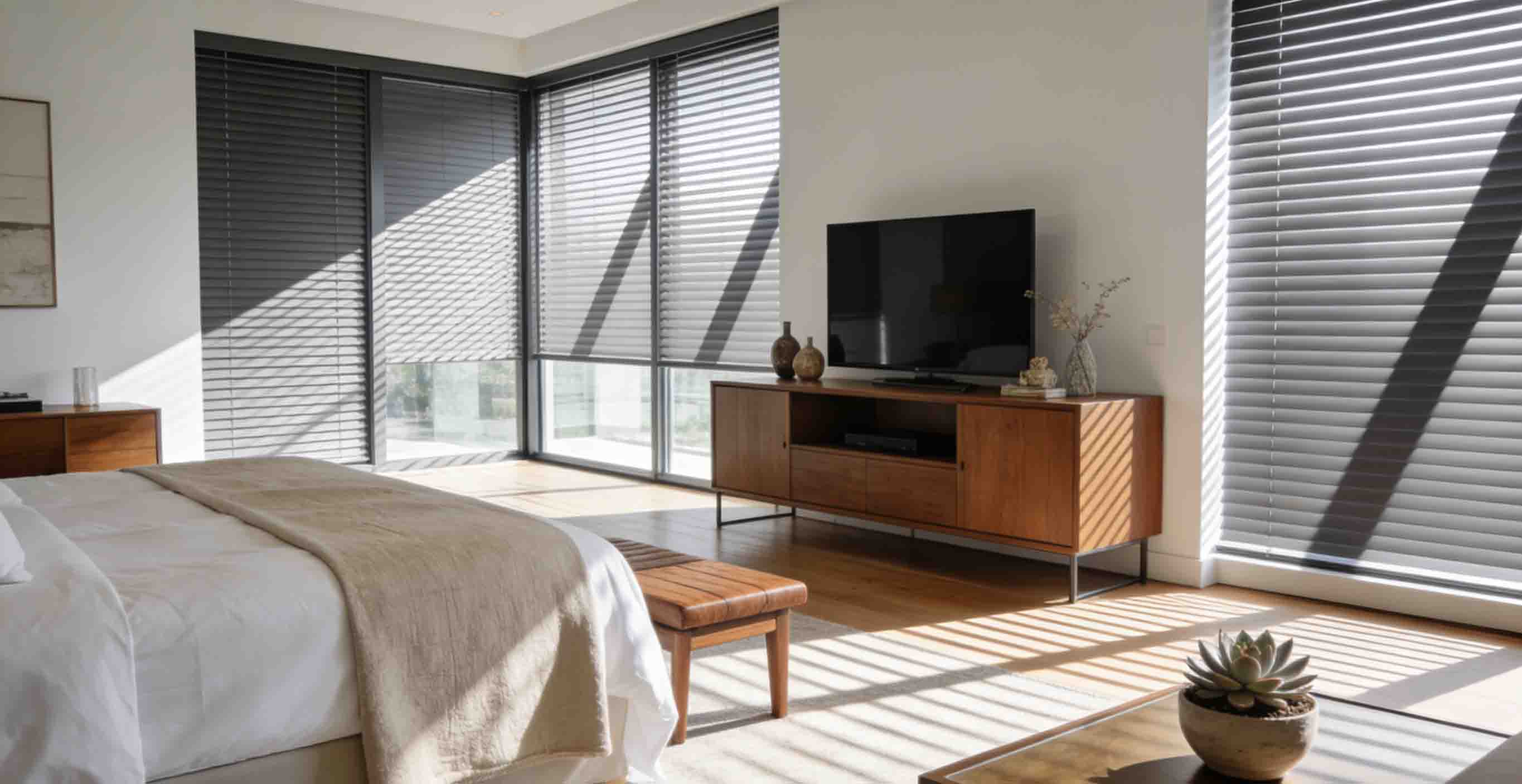
A sleek hotel room with large windows fitted with modern, neutral-colored aluminum blinds, allowing soft light to filter through. The room looks clean, professional, and serene.Project Pain Points: Why Off-the-Shelf Solutions Failed for Urban Suites
Before we found our solution, we had to fully diagnose the problem. Hotel projects aren't residential—scale, consistency, and durability aren't preferences; they're non-negotiable requirements.
The Scale & Consistency Challenge: 200 Rooms Are Not 200 Windows
The biggest misconception? Thinking 200 rooms means 200 identical windows. Urban Suites had:
- Five different window types: Standard double-hung, corner windows, narrow bathroom windows, oversized lobby windows, and arched transom windows.
- Three exposure orientations: East-facing rooms needed morning light control, west-facing needed heat rejection, north-facing needed privacy without gloom.
Off-the-shelf aluminum blinds failed immediately. The "one-size-fits-most" approach left us with gaps, poor light seal, and a cheap, unprofessional look. Customization wasn't a luxury; it was the only path to a seamless finish.
The Budget vs. Brand Aesthetics Battle
The initial budget allocated $180,000 for window treatments. The first quotes came in:
| Option | Estimated Cost | Lead Time | Key Risk |
|---|---|---|---|
| Custom Drapery & Blackout Liners | $245,000 | 18-22 weeks | Fabric dye-lot variations, high maintenance |
| Premium "Ready-Made" Blinds | $165,000 | 8-10 weeks | Visible size adjustments, limited colors, cheap mechanisms |
| Motorized Roller Shades | $310,000+ | 14-16 weeks | Complex wiring, future repair costs |
We were stuck between a product that matched our brand's aesthetic but busted the budget (drapery) and products that fit the budget but compromised our brand (ready-made). We needed a third way.
Operational Realities: Housekeeping, Safety, and Longevity
The operations director gave us non-negotiable criteria:
- Cleanable in under 3 minutes per window by housekeeping (dusting cloth only, no special tools).
- Child-safe operation (cordless or wand-controlled only to meet updated safety standards).
- 10-year functional lifespan with minimal repairs—no sagging fabrics, broken cords, or failing motors.
This operational lens immediately disqualified many aesthetically pleasing options. We needed a workhorse, not just a show pony.
The Strategic Pivot: Why Custom Aluminum Blinds Became the Winning Bid
The breakthrough came when we stopped using residential thinking. We weren't decorating windows; we were specifying a building component with performance requirements. This is where custom aluminum window blinds shifted from an alternative to the obvious choice.
Reframing the Value: Total Cost of Ownership (TCO)
We created a 7-year TCO model comparing the finalists. This changed everything:
| Cost Factor | Custom Drapery | Premium Ready-Made | Custom Aluminum Blinds |
|---|---|---|---|
| Initial Product & Install | $245,000 | $165,000 | $201,000 |
| Annual Cleaning/Maintenance | $12,000 (steam cleaning) | $5,000 | $1,500 (dusting only) |
| Replacement Rate (7 yrs) | 40% (fabric fade/wear) | 25% (mechanism failure) | <5% |
| Energy Impact (Est.) | Low-Medium | Medium | High (heat reflection) |
| 7-Year Projected TCO | $314,600 | $201,250 | $215,550 |
The aluminum window blinds had a higher upfront cost than ready-mades but beat drapery. More importantly, their low maintenance and durability made them the lowest operational cost option over time, which is what matters to hotel ownership.
The Customization Advantage: Solving Every Design Problem
Working with Hiking Glass and Mirror, we exploited the full potential of customization:
- Color Matching: We supplied a fabric swatch from the bed throw. They matched it using a RAL powder coat finish (RAL 7035, Light Grey) with a matte texture that hid fingerprints perfectly.
- Precision Sizing: Every single one of the 800 windows was measured individually by their team. No "close enough" tolerances. The result was a perfect, flush fit that made the installation look built-in.
-
Hardware & Operation: We opted for a combination:
- Guest Rooms: Cordless wand tilt for ultimate safety and clean look.
- Public Areas/High Windows: Motorized systems with a centralized wall control panel for staff.
Technical Specs That Made the Difference
Not all aluminum blinds are equal. Our spec sheet demanded and received:
- Alloy: 5005 H34 aluminum for optimal strength-to-weight ratio (no bowing in wide spans).
- Slat Thickness: 0.23mm (industry standard is 0.18mm). This extra rigidity eliminated "oil-canning" (the visible flex when light hits the slat).
- Coating: 60-80 micron polyester powder coating, tested for 1,000 hours salt spray resistance (ASTM B117).
- Headrail: Reinforced steel-reinforced headbox for silent, smooth operation of heavy blinds.
These specs added about 8% to the unit cost but were non-negotiable for commercial durability.
From Spec to Installation: A Project Manager's Timeline and Checklist
Here's the phase-by-phase roadmap we followed. Adhering to this discipline is what kept us on schedule.
Phase 1: Supplier Due Diligence (Weeks 1-2)
We shortlisted 5 suppliers. Our vetting went beyond price sheets. We asked:
- "Can you provide contact information for two past clients with a hotel project of similar scale completed in the last 18 months?"
- "What is your process for handling a production defect discovered during installation 6 months from now?"
- "Do you have in-house measuring teams in our project's city, or do you subcontract?"
Hiking Glass and Mirror won because they provided a detailed Project Risk Mitigation Plan upfront, outlining their process for handling measurement errors, shipping delays, and on-site repairs.
Phase 2: The Critical Path - Measurement & Approval Samples (Weeks 3-4)
The single most important phase. A 3mm error times 800 windows is a catastrophe.
"We allocated budget for the supplier's professional measurers to fly to site. This cost $2,500 and saved us an estimated $40,000 in rework. Never let the general contractor measure for custom blinds."
We also insisted on 3-Level Approval Samples:
- Color & Finish Sample: A 30cm painted aluminum strip, approved under both artificial and natural light.
- Working Mechanism Sample: A fully functional 1-meter wide blind to test operation, noise, and feel.
- Final Pre-Production Sample: A blind made to the exact specs of our most complex window (a corner unit). This was tested for fit on-site before full production began.
Phase 3: Production, Logistics & Pre-Shipment Inspection (Weeks 5-10)
We scheduled a Pre-Shipment Inspection (PSI) at the factory for 20% of the order, randomly selected from the packing list. We checked:
- Dimensional Accuracy: 100% of sampled units measured within ±1mm tolerance.
- Color Consistency: Compared samples from different production batches under a light booth.
- Function & Packaging: Operated every mechanism 50+ times. Verified foam inserts and corner protection in cartons.
The PSI report became part of the payment release terms. This shifted quality assurance upstream, before the goods ever left China.
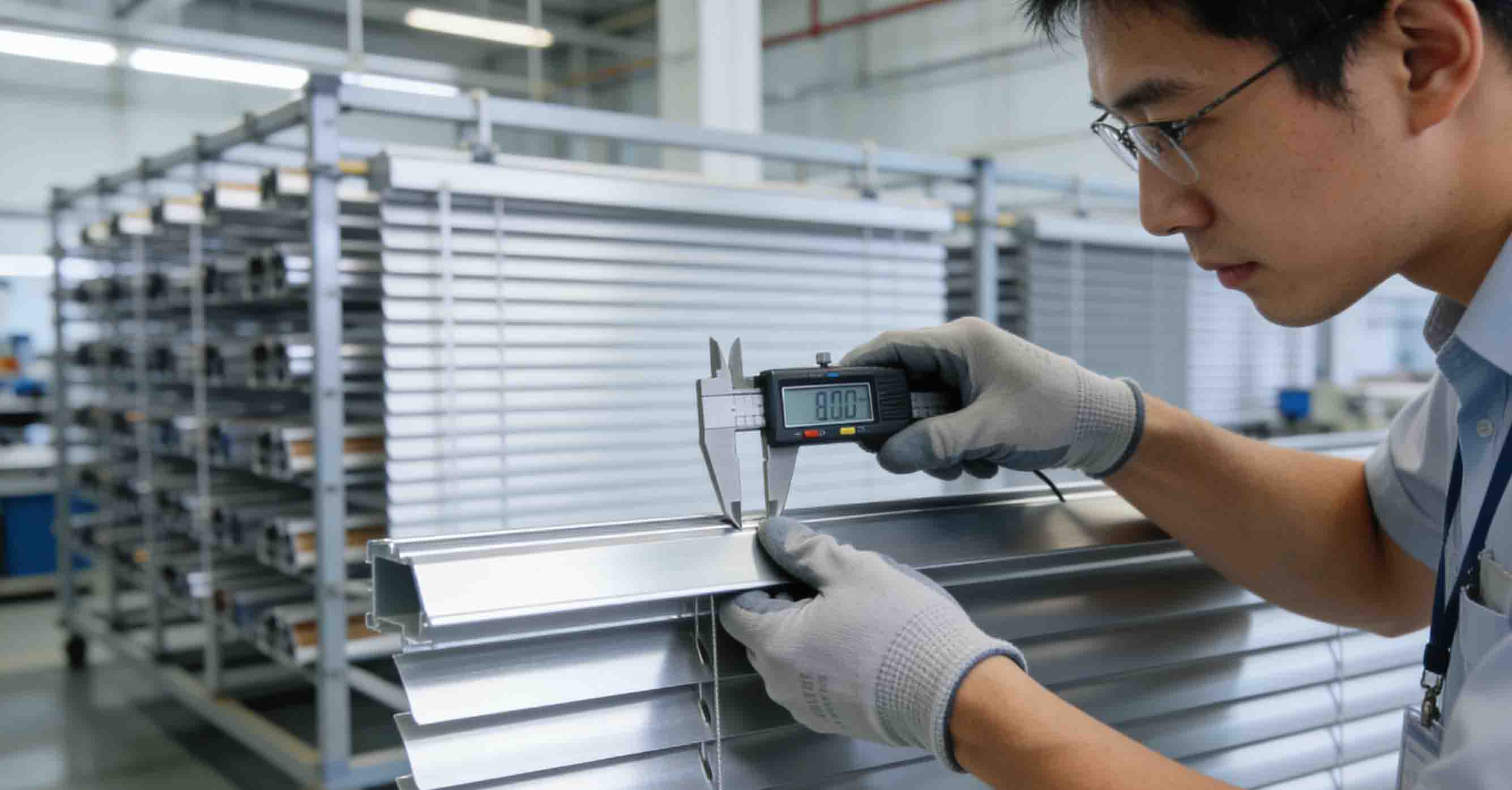
A quality control inspector in a factory using a digital caliper to measure the thickness of an aluminum blind slat, with other finished blinds in the background.Phase 4: Installation & Final Snagging (Week 11)
Installation was scheduled for after painters finished but before final cleaning. The supplier provided a two-person supervisor team for the first two days to train our installer on their specific mounting system.
Our Final Snagging List included:
- All blinds operate smoothly (no catching, no excessive noise).
- All blinds sit level when fully lowered.
- All tilt wands are aligned vertically.
- No visible scratches or coating defects from installation.
Any snag was tagged with a colored sticker, photographed, and logged for immediate correction by the supplier's team.
The Result: Measurable Outcomes and ROI for Urban Suites Hotel
Tangible Financial & Operational Results
The project concluded 3 years ago. Here's the post-mortem data:
- Budget Performance: Final window treatment cost: $201,450. Came in 11% under the revised budget of $226,000 and saved an estimated $43,550 vs. the custom drapery option.
- Schedule Performance: Installation completed in 9 working days, 2 days ahead of schedule.
- Guest Feedback: Post-stay surveys showed a 15% increase in mentions of "room comfort" and "light control" in the first year.
- Maintenance Logs: Over 3 years, only 4 service calls for blinds (0.5% failure rate), all for simple wand mechanism adjustments covered under warranty. Compare this to the drapery in the old wing, which averaged 12 repairs/year (re-hanging, track issues, torn fabric).
The Intangible Win: Brand Cohesion and Future-Proofing
Beyond numbers, the impact was visual and strategic:
- Consistency: Walking from room 101 to room 1015, the windows looked identical. This is incredibly difficult to achieve with fabric-based solutions.
- Modern Aesthetic: The slim-line aluminum blinds contributed significantly to the hotel's contemporary, clean design narrative, which was reflected in higher average daily rates (ADR).
- Procurement Blueprint: The hotel group has since used our specification and procurement process as a template for two subsequent renovation projects.
Lessons Learned: What We'd Do Differently (And You Should)
We weren't perfect. Here's our hard-earned advice:
- Order 3% Overage: We ordered exactly 800 blinds. We should have ordered 824. While the measuring was perfect, two blinds were damaged by other trades after installation. Having a small overage of matching batch-numbered blinds on-site would have saved a 6-week wait for replacements.
- Define "Cordless" Explicitly: Our initial spec said "cordless." One vendor quoted for manual tilt (no lift mechanism)—essentially, fixed blinds! Always specify "cordless lift and tilt mechanism" or "motorized operation."
- Include Installation in the Supplier's Scope: We managed installation separately. Next time, we will make it part of the supplier's turnkey responsibility. It streamlines accountability for any snags.
Your Project Blueprint: Key Questions to Ask Before Sourcing
Don't start your next project without this checklist. These questions separate the commodity suppliers from the true project partners.
Technical Specification Checklist (Provide This To All Bidders)
- Material: Aluminum alloy grade? (Request mill certificate)
- Slat Specification: Width (e.g., 25mm, 50mm)? Thickness (e.g., 0.20mm, 0.23mm)? Edge detail (rounded, square)?
- Finish: Powder coat or anodized? RAL/PPG color code? Dry film thickness? Salt spray test hours?
- Operation: Corded, cordless, wand-tilt, or motorized? For motorized: voltage, control type (RF, WiFi, hardwired), battery life?
- Headrail & Components: Material (steel-reinforced aluminum)? Bracket type (inside/outside mount)? Tilt mechanism type (plastic or metal gears)?
- Warranty: What is covered (mechanisms, coating, lifting cords)? Duration? What is the claim process?
Supplier Vetting Questionnaire
Ask these questions in your initial meeting:
- "Walk me through your process from receiving our window measurements to final installation. Where are the most common failure points, and how do you mitigate them?"
- "For a project of [X] windows in [City/Country], what would your lead time be from final approved measurements to goods ready at port? What are the 3 biggest risks to that timeline?"
- "Can you provide a detailed breakdown of costs for: a) the product, b) professional measurement service, c) shipping & insurance, d) duties, and e) any recommended spare parts?"
- "What does your Pre-Shipment Inspection report include? Can we see a redacted sample from a previous project?"
- "What is your protocol if we discover a consistent defect across multiple units during our own receiving inspection?"
Ready to Apply These Lessons to Your Project?
At Hiking Glass and Mirror, we don't just manufacture aluminum window blinds; we engineer solutions for complex commercial projects. We've walked in your shoes as project managers and procurement specialists.
Get Your Custom Project Assessment: Share your project's basic scope (number of windows, room types, key challenges), and our project consultancy team will provide a free, detailed feasibility analysis and spec outline within 12 hours.
Request Your Free Project Feasibility AnalysisNo obligation. Just actionable insights to help you plan better.
Frequently Asked Questions: Hotel-Grade Aluminum Blinds
Q1: Are aluminum blinds suitable for coastal/high-humidity hotel locations?
Yes, absolutely, but the specification is critical. For coastal properties, you must specify a high-performance polyester powder coating with a minimum 80-micron thickness and a salt spray resistance rating of 1,000 hours (ASTM B117) or higher. Avoid cheaper painted or low-quality anodized finishes, which will corrode. Always request the coating test certificate from your supplier.
Q2: What is the realistic lead time for 200+ rooms of custom aluminum blinds?
From final approved measurements and samples, plan for 8-10 weeks for production and 2-4 weeks for shipping (depending on destination and incoterm). The critical path is the measurement and approval phase, which can add 2-3 weeks. A professional supplier will give you a detailed Gantt chart. Rush orders under 8 weeks are possible but often incur 25-40% cost premiums and increase quality risks.
Q3: How do you handle color matching to existing hotel décor?
The professional process involves sending physical samples of your fabric, paint, or laminate to the factory. They will create multiple color lab dips (small painted metal samples) for your approval under different lighting conditions (D65 daylight, incandescent). Always approve a final production sample before full manufacturing begins. Industry-standard color systems like RAL or Pantone provide the most reliable matching.
Q4: What's the difference between a $25 and a $50 aluminum blind?
The price difference is in the hidden engineering: thicker aluminum gauge (less bending), higher-grade powder coating (better durability), precision-machined metal (not plastic) tilt mechanisms, and steel-reinforced headrails. The cheaper blind might look similar on day one but will develop issues like slat bowing, noisy operation, and coating chips within 12-18 months in a commercial setting.
Q5: Can you automate/motorize aluminum blinds in a hotel?
Yes, and it's increasingly common for public areas, suites, and high windows. Options include:
- Battery-powered motors: Easy retrofit, typical battery life 2-3 years with normal use.
- Hardwired motors: More reliable for high-use areas, requires wiring during construction.
- Control systems: Can be integrated into room automation systems (like Crestron or KNX) or use simple RF remotes.
Q6: How do you clean and maintain aluminum blinds in a hotel setting?
This is their key advantage. Standard procedure: fully extend the blinds, tilt slats to closed position, and use a microfiber duster or a vacuum with a soft brush attachment. For deeper cleaning, a damp cloth with mild soapy water is sufficient. Avoid abrasive cleaners or high-pressure sprays. Properly coated aluminum blinds should not require steam cleaning or chemical treatments, drastically reducing housekeeping time and cost.
Q7: What are the child safety considerations for hotel blinds?
In the US, comply with the Consumer Product Safety Commission's (CPSC) standard for corded window coverings. For hotels, the safest and most common solution is to specify cordless operation (both lift and tilt) as a standard. Alternatively, use a wand tilt system. Any cords must be made inaccessible or have tension devices. Your supplier should be fully versed in the latest safety standards for your region.
Q8: What is the typical warranty for commercial-grade aluminum blinds?
A reputable manufacturer should offer a minimum 5-year warranty on mechanisms (tilt and lift) and a 3-5 year warranty against coating fade, peeling, or corrosion under normal use. Read the warranty carefully—it should be commercial use coverage, not just residential. Ensure it covers parts, labor, and shipping for defective items.
Q9: How do you handle repairs or replacements for individual blinds years later?
This is crucial. During procurement, order and pay for 2-3% of the total quantity as immediate spare parts to be stored on-site. Also, ensure your supplier archives your custom color formula and technical drawings. A good supplier will be able to manufacture a single replacement blind 5 years later that matches the original batch. Confirm this policy in writing before ordering.
Q10: What's the biggest mistake you see buyers make when sourcing aluminum blinds?
Focusing solely on price per unit instead of total project cost. The true cost includes measurement accuracy (errors cause huge delays), installation efficiency (poor design makes installers take 2x longer), durability (frequent replacements), and maintenance (hard-to-clean designs). A slightly more expensive, well-engineered blind with professional project management always has a lower total cost of ownership for a hotel.
Further Reading & Technical Resources
To deepen your understanding of commercial window treatment specifications and standards, we recommend these authoritative resources:
- "The Impact of Window Treatments on Guest Experience & Operational Efficiency" - Hospitality Net
- "North American Fenestration Standard (NAFS) - Guide to Performance Grades" - American Window & Door Institute
- "CPSC Business Guidance for Corded Window Coverings" - U.S. Consumer Product Safety Commission